- Home
- EN
- Our impact
- ProspeKtive
- Reuse: towards a resource-based approach to architecture
Reuse: towards a resource-based approach to architecture
December 2025
Expert
Dr Safa Ben Khedher
Dr Safa Ben Khedher
Architect "DE-HMONP"
Doctor or Architecture and Cities
Founder of REUSAGE
Member of the Board of Directors of the Raediviva Association
When we look at reuse in the construction industry, we see that a large number of studies and research projects focus on the supply chain: how to build with reused materials such as wood, steel, etc. However, there is little information available on practices, implementation, or whether current project procedures are compatible with reuse and recycling initiatives.
As the ecological transition accelerates, we need to provide insights into the challenges associated with reuse and food for thought on our ability to adapt to changing practices and projects.
Background information
In France, the construction industry consumes 460 million tonnes of materials and minerals per year, or 7 tonnes per capita per year. It also generates 42 million tonnes of waste per year, equivalent to four times the weight of the Eiffel Tower. This enormous amount of waste is mainly generated by demolition, construction and renovation, with 74% of waste related to structural work and 26% to finishing work, mainly inert waste.
Since 2020, the AGEC (Anti-Waste for a Circular Economy) law has encouraged construction industry players to preserve materials, products and equipment, reduce waste and combat wastefulness. A number of funds are available to finance reuse and recycling initiatives (from the State, ADEME, the Region, etc.).
Since 1 January 2024, the AGEC law has required project owners to carry out a PEMD (Products, Equipment, Materials, Waste) assessment and recommends solutions for reuse, recycling and recycling. This assessment applies to both demolition and significant renovation work as soon as the floor area exceeds 1,000 m².
Currently, there is a shortage of construction materials and an increase in the price of raw materials. In response to this situation, the government is introducing incentives to promote reuse:
- Waste recovery is now cheaper than disposal (-€10/tonne).
- An increase in the TGAP (General Tax on Polluting Activities) of €18/tonne.
- A reduction in VAT on separate collection, sorting and recycling from 10% to 5.5%.
- VAT at 5.5% on repairs.
What is reuse?
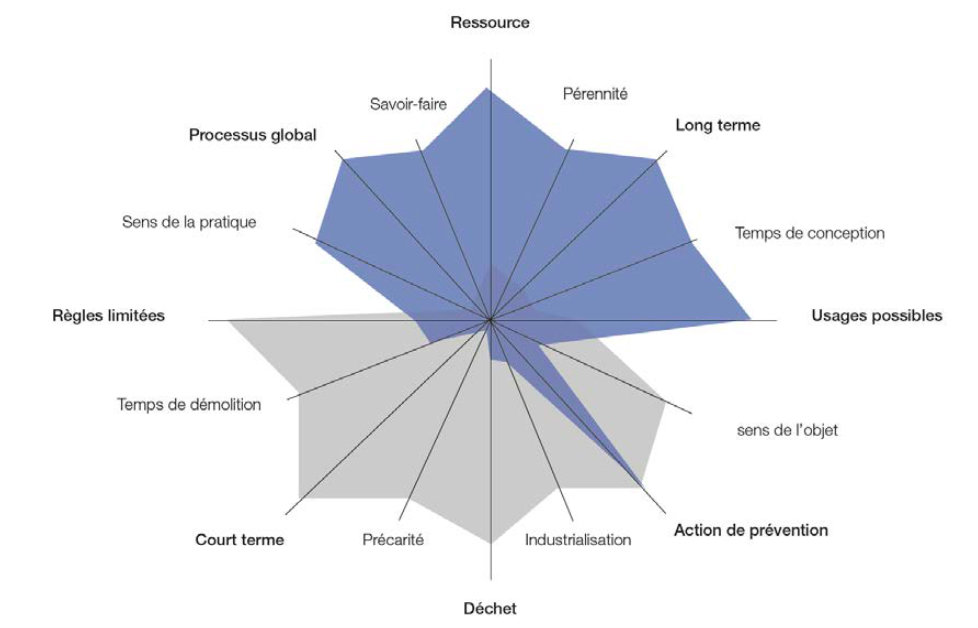
The practice of reuse ® Safa Ben Khedher, 2021
Where the law calls for a move towards reuse, those involved in the construction industry are highlighting the need to change practices in order to integrate and develop reuse. This nuance allows us to propose a new concept, ‘reuse’, and its definition: ‘Any operation that enables the sustainable use of an available resource’.
In this concept, the act of reuse itself is not a central issue. What is important is to be part of a more global framework within which we will learn to think about reuse on a case-by-case basis, establishing scenarios according to the project and its specificities. With this new paradigm, for the products, materials and resources concerned, the idea is to move from the status of ‘waste’, as defined by regulations, to that of ‘resource’, from the concept of “reuse” to that of ‘repurposing’.
From an operational point of view, the key word is anticipation. Very early on in the project, it is necessary to consider the type of work, the resources available, the actors and skills required, the methods to be used, etc. This upstream work raises the question of architects' remuneration. Today, they are paid on the basis of a percentage of the cost of the work. This does not take into account the value of the preliminary phase (planning, prototyping, experimentation, etc.).
From an economic perspective, the practice of ‘reuse’ requires an appropriate economic model. We are in the early stages of experimenting with this emerging practice. It is important to devote time to it, and it is therefore too early to consider making money from reuse. That said, some avenues for budget optimisation are already identifiable. Research and development funding, offered in particular by state-approved eco-organisations, can be used to finance the upstream phases of experimentation mentioned above (PEMD diagnostics, prototyping, tools for evaluating, tracing and monitoring materials, etc.).
Conclusion
Reuse is changing the profession of architecture due to the need to integrate new specific skills: consulting, diagnostics, mediation, etc. However, architects currently do not have the means to respond to this shift towards multidisciplinary skills. For this reason, they can no longer work alone throughout the design phase.
Either they are valued for what they do and can therefore integrate these new skills, or competent external actors must be integrated into the process once the tasks have been identified.
‘Reuse’ is now emerging as an architectural material, meaning that existing and available resources are considered first and foremost as basic data for designing a project.
This practice invites us to change our perspective and evolve culturally, moving from the notion of waste to the notion of resources.
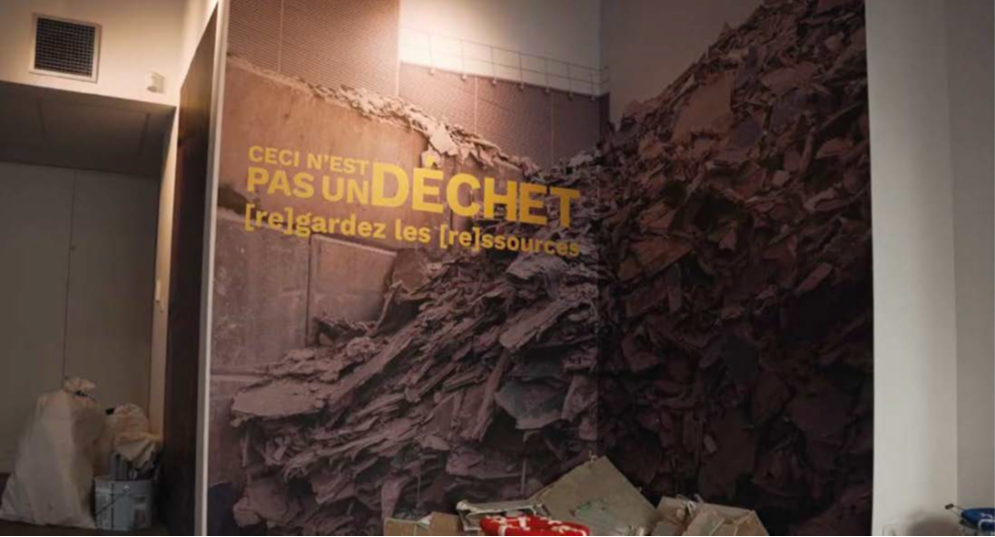
Exhibition ‘This is not waste – [Re]considering [re]sources’ ® CAUE du Var.*
Release date: December 2025
Read more
When the waiting room shapes our impressions
Dr Judith Partouche-Sebban

Dr Judith Partouche-Sebban
Full Professor in Marketing
Head of Living Health Chair
Dr Daniel Maar
Dr Daniel Maar
Associate Professor of Marketing, Paris School of Business
Dr Gisele de Campos Ribeiro

Dr Gisele de Campos Ribeiro
Associate Professor of Marketing, Paris School of Business